How Keyword Gap Analysis Powers Topic Clusters
 Thu Nghiem
Keyword gap analysis is more than an SEO tactic—it’s a strategic tool to strengthen topic clusters, improve topical authority, and drive organic growth. Learn how to use it to build comprehensive, high-ranking content that converts.
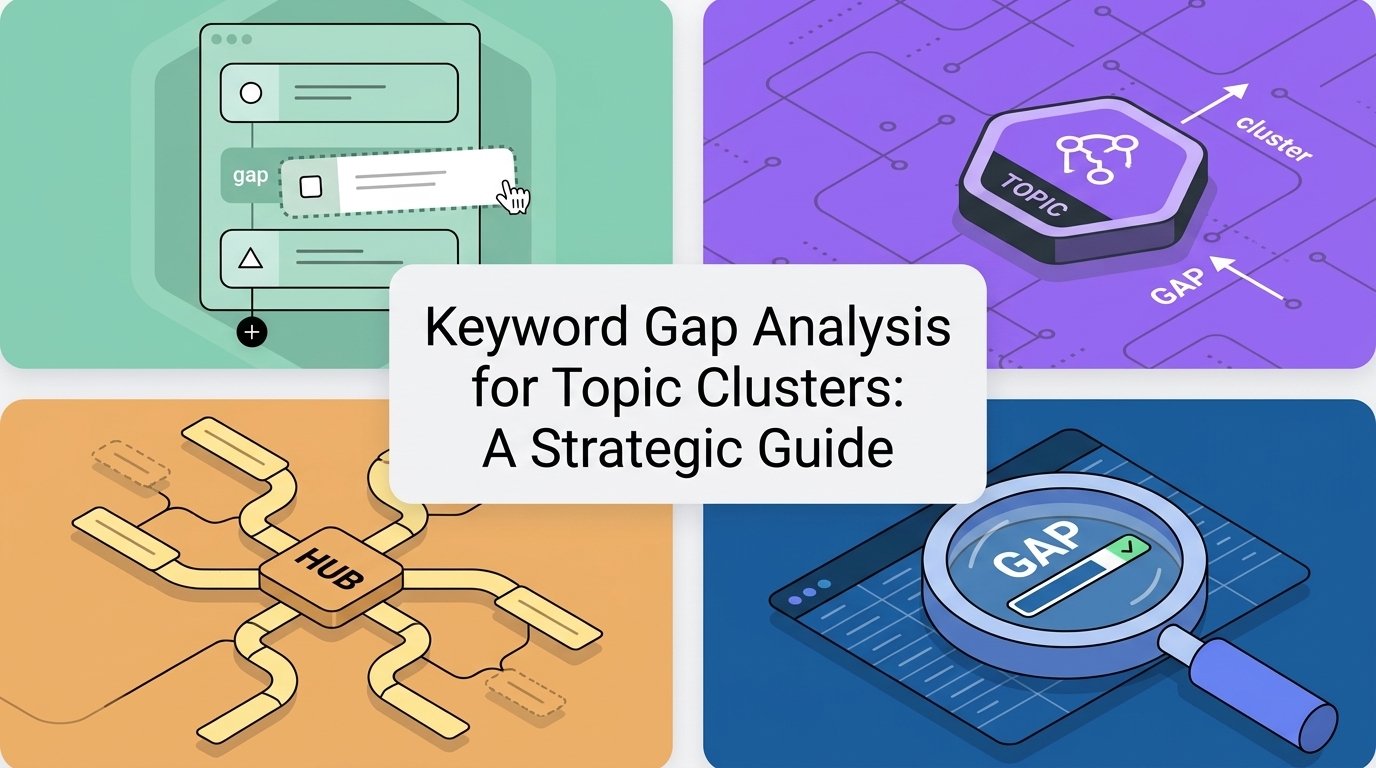
Keyword gap analysis is often treated as a tactical SEO exercise—find missing keywords, plug them into content, and move on. But when you pair it with a topic cluster strategy, it becomes something far more powerful: a roadmap for building comprehensive, authoritative content that ranks and converts.
For content marketers and SEO specialists, the real value isn’t just in discovering what keywords competitors rank for. It’s in identifying the content gaps that prevent your topic clusters from being complete. Without this insight, you risk creating clusters that feel disjointed, miss key user questions, or fail to cover the full breadth of a topic—leaving your site vulnerable to competitors who do.
This guide explains how to use keyword gap analysis as a strategic tool to strengthen your topic clusters, improve topical authority, and drive organic growth.
What Is Keyword Gap Analysis?
Keyword gap analysis is the process of comparing your website’s keyword rankings against those of your competitors to identify terms you’re missing. It’s not just about finding high-volume keywords—it’s about uncovering relevant gaps that align with user intent and your content strategy.
Common Misconceptions
Many marketers assume keyword gap analysis is only about volume. They chase keywords with the highest search numbers, only to create content that doesn’t resonate with their audience. Others treat it as a one-time audit, rather than an ongoing process tied to their content roadmap.
The real opportunity lies in using gap analysis to inform your topic cluster strategy. When you analyze gaps through the lens of clusters, you’re not just finding missing keywords—you’re identifying missing content that could complete your hub-and-spoke model.
How Gaps Relate to Topic Clusters
A topic cluster is a group of interlinked pages centered around a core topic (the pillar) and supported by related subtopics (cluster content). For example:
- Pillar page: The Ultimate Guide to Remote Work
- Cluster content: Best Tools for Remote Teams, How to Set Up a Home Office, Remote Work Productivity Tips
Gaps in your keyword data often reveal missing cluster content. If competitors rank for remote work productivity tips and you don’t, that’s not just a missing keyword—it’s a missing piece of your cluster. Filling it strengthens your topical authority and improves your chances of ranking for the broader pillar topic.
Why Topic Clusters Need Keyword Gap Analysis
Topic clusters are more than an SEO tactic—they’re a framework for organizing content in a way that serves both search engines and users. But clusters only work if they’re complete. Here’s why gap analysis is essential:
1. Clusters Require Comprehensive Coverage
A topic cluster is only as strong as its weakest link. If your pillar page covers remote work but lacks supporting content on time management for remote teams, users (and search engines) will notice the gap. Competitors who cover that subtopic will appear more authoritative.
Gap analysis reveals these missing pieces, allowing you to:
- Identify subtopics you haven’t addressed.
- Spot variations of keywords (e.g., remote work tools vs. tools for remote teams) that could diversify your cluster.
- Uncover long-tail opportunities that competitors overlook.
2. Gaps Disrupt the User Journey
Users don’t consume content in isolation. They follow a journey—from broad questions (What is remote work?) to specific ones (How do I stay productive while working remotely?). If your cluster is missing a step in that journey, users will leave your site to find answers elsewhere.
For example, if your pillar page ranks for remote work but lacks content on remote work tax deductions, users searching for that term will bounce to a competitor. Gap analysis helps you map your cluster to the full user journey, ensuring no step is missing.
3. Gaps Weaken Internal Linking
Internal links are the glue that holds topic clusters together. They signal to search engines which pages are most important and how they relate to each other. But if your cluster is incomplete, your internal linking opportunities shrink.
For instance:
- A pillar page on remote work should link to remote work tools, remote work productivity, and remote work tax tips.
- If you’re missing one of those subtopics, you lose a valuable internal link—and the SEO benefits that come with it.
Gap analysis helps you identify these missing links before they become a problem.
4. Gaps Hurt Topical Authority
Search engines reward sites that demonstrate topical authority—a deep, comprehensive understanding of a subject. If your cluster is missing key subtopics, search engines may view your content as incomplete or less authoritative than competitors’.
For example, if you’re writing about content marketing but don’t cover content distribution strategies, search engines may rank a competitor’s cluster higher because it’s more thorough. Gap analysis ensures your cluster covers the full spectrum of a topic, boosting your authority in the process.
How to Perform Keyword Gap Analysis for Topic Clusters
Keyword gap analysis isn’t just about running a report—it’s about using that data to build stronger topic clusters. Here’s a step-by-step process to turn gaps into actionable insights.
Step 1: Identify Your Competitors
Not all competitors are created equal. For gap analysis, you need to focus on:
- Direct competitors: Sites targeting the same audience and keywords as you.
- Indirect competitors: Sites ranking for terms you want to target, even if they’re not in your industry.
How to find them:
- Use tools like Ahrefs or SEMrush to see who ranks for your target keywords.
- Look at the “Competing Domains” report in your SEO tool to identify sites overlapping with yours.
- Check Google’s “Sites also ranking for” feature in tools like Ahrefs to uncover indirect competitors.
Pro tip: Don’t limit yourself to 2-3 competitors. The more data you have, the more gaps you’ll uncover.
Step 2: Extract Keyword Data
Once you’ve identified competitors, use an SEO tool to extract their keyword rankings. Most tools offer a “Content Gap” or “Keyword Gap” feature that compares your site’s rankings to competitors’.
Tools to use:
- Ahrefs: Content Gap tool
- SEMrush: Keyword Gap tool
- Moz: Keyword Explorer (for manual comparisons)
- Ubersuggest: Free option for basic gap analysis
What to look for:
- Keywords competitors rank for that you don’t.
- Keywords where competitors rank higher than you.
- Keywords with high search volume and low competition.
Pro tip: Filter for keywords with a minimum search volume (e.g., 100+ monthly searches) to focus on terms with real traffic potential.
Step 3: Filter for Relevant Gaps
Not all gaps are worth filling. To prioritize effectively, filter your data by:
- Search intent: Does the keyword align with your audience’s needs? (e.g., informational, commercial, navigational)
- Relevance: Does the keyword fit your topic cluster? (e.g., remote work tools fits a remote work cluster; best laptops for remote work might not)
- Difficulty: Can you realistically rank for this keyword? (Use tools like Ahrefs’ Keyword Difficulty score to assess.)
- Opportunity: Is there a gap in the SERPs? (e.g., Are top results outdated or low-quality?)
Example:If you’re building a cluster around content marketing, a gap like how to create a content calendar is relevant and actionable. A gap like best content marketing agencies might not fit your cluster unless you’re targeting service-based content.
Step 4: Map Gaps to Your Topic Cluster Structure
Now that you’ve identified relevant gaps, it’s time to map them to your topic cluster. Ask:
- Is this a pillar or cluster content opportunity?
- Pillar content: Broad, high-level topics (e.g., The Ultimate Guide to Content Marketing).
- Cluster content: Specific subtopics (e.g., How to Create a Content Calendar).
- Does this gap fill a missing piece in my cluster?
- If your cluster is missing a subtopic, prioritize it.
- If the gap is a variation of an existing subtopic, consider updating or expanding that content.
- How does this fit into the user journey?
- Does the keyword represent an early-stage question (e.g., What is content marketing?) or a late-stage one (e.g., Best tools for content marketing)?
Example:For a remote work cluster, gaps might map like this:
Gap KeywordContent TypeCluster Roleremote work productivityClusterSupports pillar on remote workbest tools for remote teamsClusterSupports pillar on remote workremote work tax deductionsClusterNew subtopic for the cluster
Step 5: Prioritize Gaps Based on Opportunity
Not all gaps are equal. Prioritize them based on:
- Search volume: Higher volume = more traffic potential.
- Keyword difficulty: Lower difficulty = easier to rank.
- Business goals: Does this align with your content strategy? (e.g., If you’re launching a remote work tool, best tools for remote teams is a high-priority gap.)
- Competitor weakness: Are competitors ranking poorly for this term? (e.g., Low-quality content or outdated information.)
Pro tip: Use a scoring system to prioritize gaps. For example:
- Search volume: 1-5 (5 = highest)
- Keyword difficulty: 1-5 (1 = lowest)
- Business relevance: 1-5 (5 = highest)
- Competitor weakness: 1-5 (5 = weakest)
Add up the scores and tackle the highest-scoring gaps first.
Tools and Workflows for Efficiency
Keyword gap analysis can be time-consuming, but the right tools and workflows can streamline the process. Here’s how to work smarter, not harder.
Top Tools for Gap Analysis
ToolBest ForPricing (2026)Key FeatureAhrefsComprehensive gap analysis$99+/monthContent Gap tool, SERP analysisSEMrushCompetitor comparisons$129+/monthKeyword Gap tool, trend dataMozManual gap analysis$99+/monthKeyword Explorer, difficulty scoresUbersuggestFree/low-cost gap analysisFree-$49/monthBasic gap comparisonsSurfer SEOContent optimization$59+/monthSERP analyzer, content gaps
Pro tip: Combine tools for better insights. For example:
- Use Ahrefs for gap analysis.
- Use Surfer SEO to optimize content for those gaps.
Workflow Tips for Efficiency
- Automate reports: Set up weekly or monthly gap analysis reports in your SEO tool to track progress.
- Use templates: Create a standard template for gap analysis (e.g., Google Sheets or Notion) to streamline prioritization.
- Integrate with content planning: Connect your gap analysis data to tools like Notion, Airtable, or Trello to turn gaps into actionable content briefs.
- Track progress: Monitor rankings for your gap keywords over time to measure success.
Example workflow:
- Run a gap analysis in Ahrefs.
- Export the data to Google Sheets.
- Filter and prioritize gaps using a scoring system.
- Add high-priority gaps to your content calendar in Notion.
- Track rankings in Ahrefs or SEMrush.
From Gaps to Content: Building Your Cluster
Identifying gaps is only the first step. The real work begins when you turn those gaps into high-quality, cluster-optimized content. Here’s how to do it effectively.
1. Turn Gaps into Content Briefs
A content brief ensures your writers or team create content that fills the gap and aligns with your cluster strategy. Include:
- Target keyword: The gap keyword you’re targeting.
- Search intent: What is the user looking for? (e.g., informational, commercial)
- Content type: Blog post, guide, video, etc.
- Cluster role: How does this fit into your topic cluster? (e.g., pillar, cluster content)
- Internal linking opportunities: Which existing pages should link to this content?
- Competitor analysis: What are competitors doing well (or poorly) with this topic?
- Content structure: Outline headings, subtopics, and key points to cover.
Example brief for remote work productivity:
- Target keyword: remote work productivity
- Search intent: Informational (users want tips to improve productivity)
- Content type: Blog post
- Cluster role: Cluster content supporting The Ultimate Guide to Remote Work
- Internal links: Link to pillar page, best tools for remote teams, and remote work tax deductions
- Competitor analysis: Competitors’ posts lack actionable tips; focus on step-by-step advice.
- Structure:
- H1: How to Boost Remote Work Productivity: 10 Proven Tips
- H2: Why Remote Work Productivity Matters
- H2: 10 Tips to Stay Productive While Working Remotely
- H3: Tip 1: Set Up a Dedicated Workspace
- H3: Tip 2: Use Time-Blocking Techniques
2. Best Practices for Internal Linking
Internal links are the backbone of topic clusters. They signal to search engines which pages are most important and how they relate to each other. Follow these best practices:
- Link from pillar to cluster content: Every cluster page should link back to the pillar.
- Link between cluster pages: If two cluster pages are related (e.g., remote work tools and remote work productivity), link them to each other.
- Use descriptive anchor text: Avoid generic phrases like “click here.” Instead, use keyword-rich anchor text (e.g., learn more about remote work productivity tips).
- Link naturally: Don’t force links. If a link doesn’t add value to the reader, leave it out.
Example:In your remote work productivity post, include links like:
- “For more tips on setting up your workspace, check out our guide to creating a home office.”
- “To stay organized, try these best tools for remote teams.”
3. Measure Success
Tracking the performance of your gap-filled content ensures your efforts are paying off. Monitor:
- Rankings: Are you ranking for the target keyword? Use tools like Ahrefs or SEMrush to track progress.
- Traffic: Is the content driving organic traffic? Check Google Analytics or Search Console.
- Engagement: Are users spending time on the page? Look at metrics like time on page and bounce rate.
- Conversions: Is the content driving leads, sign-ups, or sales? Set up goals in Google Analytics to track conversions.
Pro tip: Set benchmarks before publishing. For example:
- Goal: Rank in the top 10 for remote work productivity within 3 months.
- Goal: Increase organic traffic to the pillar page by 20% after linking cluster content.
Common Mistakes to Avoid
Keyword gap analysis is powerful, but it’s easy to make mistakes that undermine your efforts. Here are the most common pitfalls—and how to avoid them.
1. Chasing Irrelevant or Low-Intent Keywords
Not all gaps are worth filling. Avoid keywords that:
- Don’t align with your audience’s needs.
- Have low search volume or high competition.
- Don’t fit your topic cluster.
Example:If you’re building a cluster around content marketing, a gap like best laptops for marketers might not be relevant—even if it has high search volume.
Fix: Filter gaps by relevance and intent before prioritizing them.
2. Ignoring User Intent
User intent is the why behind a search query. If you ignore it, you’ll create content that doesn’t satisfy users—and search engines will notice.
Example:A keyword like remote work could have multiple intents:
- Informational: What is remote work?
- Commercial: Best remote work tools
- Navigational: Remote work jobs at [Company]
Fix: Analyze the SERPs for your target keyword to determine intent. If top results are blog posts, create a blog post. If they’re product pages, consider a commercial piece.
3. Overlooking Internal Linking Opportunities
Internal links are critical for topic clusters, but many marketers treat them as an afterthought. This weakens your cluster’s structure and SEO potential.
Example:If you publish a new cluster page on remote work productivity but forget to link it to your pillar page, search engines won’t understand the relationship between the two.
Fix: Include internal linking in your content briefs and review every new piece for linking opportunities.
4. Treating Gap Analysis as a One-Time Task
Keyword gap analysis isn’t a “set it and forget it” activity. Competitors evolve, search trends shift, and new gaps emerge over time.
Example:A competitor might publish a new guide on remote work tax deductions, creating a gap in your cluster that didn’t exist before.
Fix: Schedule regular gap analysis audits (e.g., quarterly) to stay ahead of competitors.
5. Focusing Only on Volume
High search volume doesn’t always equal opportunity. A keyword with 10,000 monthly searches but ultra-high competition might not be worth targeting—especially if your site is new or lacks authority.
Example:A keyword like SEO has massive volume, but ranking for it is nearly impossible for most sites. A long-tail keyword like how to do keyword gap analysis for topic clusters has lower volume but is far more achievable.
Fix: Balance volume with difficulty and relevance. Prioritize keywords where you have a realistic chance to rank.
Key Takeaways
Keyword gap analysis is more than a tactical SEO exercise—it’s a strategic tool for building stronger topic clusters. Here’s what to remember:
- Gaps reveal missing cluster content: Use gap analysis to identify subtopics that complete your clusters and improve topical authority.
- Clusters need comprehensive coverage: Incomplete clusters disrupt the user journey and weaken internal linking.
- Prioritize relevance and intent: Not all gaps are worth filling. Focus on keywords that align with your audience’s needs and business goals.
- Turn gaps into actionable content: Use content briefs to guide writers and ensure new content fits your cluster strategy.
- Internal links are critical: They signal to search engines how your content is connected and which pages are most important.
- Measure success: Track rankings, traffic, and engagement to ensure your gap-filled content is driving results.
- Avoid common mistakes: Don’t chase irrelevant keywords, ignore user intent, or treat gap analysis as a one-time task.
By integrating keyword gap analysis into your topic cluster strategy, you’ll create content that’s not only comprehensive but also competitive. The result? Higher rankings, more organic traffic, and a stronger presence in your niche.