AI Writer: What It Is, How It Works, and When to Use One
 Thu Nghiem
AI writers are transforming content creation by offering speed and scalability for marketers, SEO teams, and business owners. Learn what an AI writer is, how it works, key use cases, benefits, limitations, and best practices to integrate one into your workflow effectively.
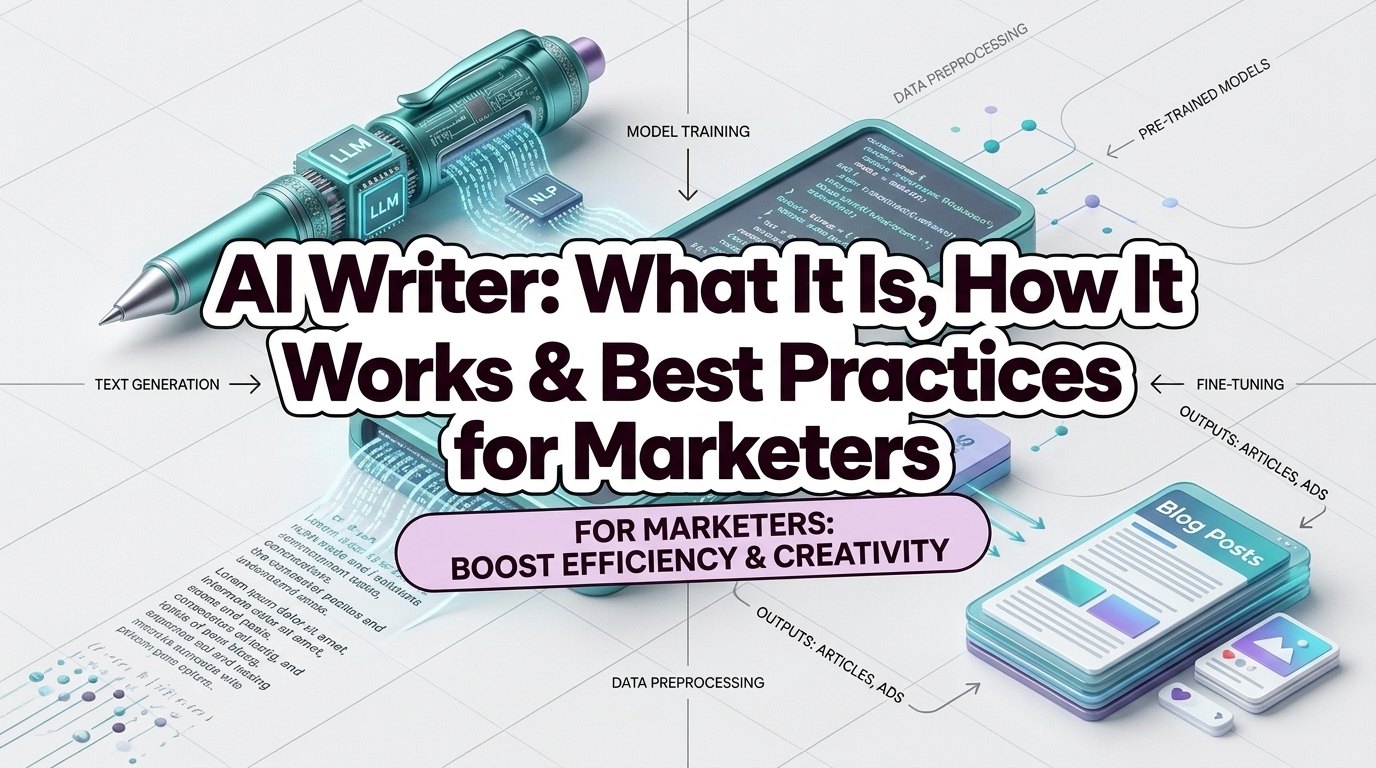
AI writers are reshaping content creation. For marketers, SEO teams, and business owners, they offer speed and scalability—but also raise questions about quality, ethics, and strategy. If you're evaluating whether an AI writer fits into your workflow, this guide covers what it is, how it works, key use cases, and best practices for using one effectively.
What Is an AI Writer?
An AI writer is a tool powered by artificial intelligence that generates text based on prompts, data, and machine learning models. Unlike traditional writing tools—such as grammar checkers or spellcheck—AI writers don’t just edit or correct text. They create it from scratch, often in seconds.
How AI Writers Differ from Traditional Tools
Traditional writing tools (e.g., Grammarly, Hemingway) focus on refining existing text. AI writers, on the other hand, generate new content. For example:
- Grammar checker: Flags errors in a draft you’ve already written.
- AI writer: Produces a full blog post or social media caption based on a prompt like, "Write a 500-word blog post about sustainable fashion trends in 2027."
Types of AI Writers
AI writers come in different flavors, each suited to specific tasks:
- General-purpose AI writers: Tools like GPT-4 or Claude, which can handle a wide range of topics (e.g., blogs, emails, scripts).
- Niche-specific AI writers: Designed for industries like legal, medical, or technical writing (e.g., tools that generate compliance reports or clinical summaries).
- SEO-optimized AI writers: Focused on keyword integration, meta descriptions, and content clusters (e.g., SurferSEO’s AI writer or Frase).
- Chatbot-style AI writers: Interactive tools (e.g., Jasper Chat, Copy.ai) that generate text in a conversational format.
A Brief History of AI Writers
AI writing isn’t new, but its capabilities have evolved dramatically:
- 2010s: Rule-based chatbots (e.g., early customer service bots) relied on predefined scripts.
- 2018–2020: The rise of transformer models (e.g., BERT, GPT-2) enabled more natural language generation.
- 2022–2026: Large language models (LLMs) like GPT-3.5 and GPT-4 made AI writers accessible to non-technical users, with improved coherence and creativity.
Today, AI writers are used for everything from drafting emails to generating full-length articles—but they’re not without limitations.
How AI Writers Work
At their core, AI writers rely on two key technologies: Natural Language Processing (NLP) and Large Language Models (LLMs). Here’s how they turn prompts into text.
Core Technology
- Natural Language Processing (NLP): Enables the AI to understand and generate human-like text. NLP breaks down language into patterns, allowing the AI to predict the next word in a sentence.
- Large Language Models (LLMs): Trained on vast datasets (e.g., books, articles, websites), LLMs like GPT-4 or Google’s Gemini learn the relationships between words, phrases, and concepts. When you input a prompt, the LLM generates text by predicting the most likely sequence of words based on its training.
Inputs: What You Feed the AI
AI writers don’t work in a vacuum. They rely on inputs to generate relevant output. Common inputs include:
- Prompts: The instructions you provide (e.g., "Write a LinkedIn post about remote work trends in 2027").
- Tone and style guidelines: Specify whether the text should be formal, casual, humorous, or technical.
- Keywords: For SEO-focused content, you might include target keywords (e.g., "best AI tools for marketers").
- Context: Additional details like audience (e.g., "for small business owners"), intent (e.g., "persuasive"), or examples of desired output.
Outputs: What the AI Generates
Depending on the tool and settings, AI writers can produce:
- Drafts: Full articles, blog posts, or reports.
- Outlines: Structured frameworks for longer content.
- Rewrites: Paraphrased or expanded versions of existing text.
- Short-form content: Social media captions, email subject lines, or product descriptions.
Limitations of AI Writers
While powerful, AI writers have inherent limitations:
- Lack of true understanding: AI doesn’t "understand" text in the way humans do. It predicts word sequences based on patterns, which can lead to inaccuracies or nonsensical output.
- Bias: AI models reflect the biases present in their training data. For example, an AI writer might default to gendered language or stereotypes if not carefully prompted.
- Need for human review: AI-generated text often requires editing for accuracy, brand voice, and originality. Without oversight, it can produce generic or off-brand content.
Key Use Cases for AI Writers
AI writers are versatile tools, but their value depends on how you use them. Here are some of the most common use cases for marketers and content teams.
Content Creation
AI writers excel at generating drafts for:
- Blog posts: Quickly produce outlines or full drafts on topics like "How to Use AI for Customer Support in 2027."
- Social media captions: Generate multiple variations for platforms like LinkedIn, Instagram, or Twitter.
- Product descriptions: Create unique, SEO-friendly descriptions for e-commerce listings.
- Email copy: Draft newsletters, promotional emails, or drip campaigns.
SEO Optimization
AI writers can help with:
- Keyword-rich content: Generate articles optimized for target keywords (e.g., "best project management tools for remote teams").
- Meta descriptions: Create concise, click-worthy meta descriptions for blog posts or product pages.
- Content clusters: Develop topic clusters for pillar pages (e.g., a central guide on "AI in Marketing" with supporting articles on subtopics).
Scaling Output
AI writers enable teams to:
- Repurpose content: Turn a blog post into a script for a video or a series of social media posts.
- Localize content: Adapt content for different markets or languages (e.g., translating a blog post into Spanish or German).
- Generate variations: Create multiple versions of an ad or landing page to A/B test messaging.
Brainstorming
AI writers can spark ideas for:
- Headlines: Generate catchy titles for blog posts or articles.
- Outlines: Develop structured outlines for long-form content.
- Content angles: Suggest unique perspectives on a topic (e.g., "Write about AI in healthcare from the perspective of a nurse").
Localization
For global teams, AI writers can:
- Translate content: Generate drafts in multiple languages while preserving tone and intent.
- Adapt cultural references: Modify examples or idioms to resonate with local audiences.
Benefits of Using an AI Writer
AI writers offer several advantages for marketers and content teams, especially when used strategically.
Speed
AI writers can generate drafts in seconds, significantly reducing content production time. For example:
- A 1,000-word blog post might take a human writer 2–4 hours to draft. An AI writer can produce a first draft in under a minute.
- Social media captions or email subject lines can be generated in bulk, saving hours of manual work.
Cost Efficiency
For high-volume or repetitive content, AI writers can lower costs:
- Product listings: E-commerce teams can use AI to generate hundreds of product descriptions without hiring additional writers.
- SEO content: Agencies can scale content production for clients without increasing headcount.
Consistency
AI writers maintain tone and style across large teams or multiple writers. For example:
- A brand can use an AI writer to ensure all blog posts adhere to its voice guidelines (e.g., "friendly but professional").
- Large organizations can standardize messaging across departments (e.g., HR, marketing, customer support).
Accessibility
AI writers enable non-writers to create drafts:
- Founders: Can draft blog posts or social media content without hiring a copywriter.
- Marketers: Can generate email campaigns or ad copy without relying on a writing team.
Data-Driven Insights
Some AI writing tools analyze trends or suggest improvements:
- SEO tools: Recommend keywords or content structures based on search data.
- Performance analytics: Track engagement metrics (e.g., time on page, conversions) to refine future content.
Limitations and Risks
While AI writers offer many benefits, they also come with challenges. Understanding these limitations is key to using them effectively.
Quality Control
AI-generated content can be:
- Generic: Without careful prompting, output may lack originality or brand voice.
- Inaccurate: AI writers can "hallucinate" facts or produce misleading information.
- Off-brand: Tone or messaging may not align with your brand guidelines.
Solution: Always review and edit AI-generated content for accuracy, originality, and brand alignment.
Ethical Concerns
AI writers raise several ethical issues:
- Plagiarism: AI models are trained on existing content, which can lead to unintentional plagiarism.
- Bias: AI writers may reflect biases present in their training data (e.g., gender, racial, or cultural biases).
- Transparency: Audiences may expect disclosure when content is AI-generated (e.g., for compliance or trust).
Solution: Use plagiarism checkers, audit content for bias, and disclose AI use when necessary.
SEO Risks
Over-reliance on AI writers can lead to:
- Thin content: Low-quality or repetitive content that doesn’t provide value to readers.
- Over-optimization: Keyword stuffing or unnatural phrasing that harms readability and rankings.
Solution: Use AI writers for drafts, then refine content for quality and SEO best practices.
Creativity Gaps
AI writers struggle with:
- Original ideas: They generate text based on existing patterns, not true creativity.
- Humor or nuance: Sarcasm, irony, or emotional storytelling often fall flat.
- Complex narratives: Long-form content with intricate plots or character development is challenging.
Solution: Use AI for brainstorming or first drafts, then refine with human creativity.
Dependency
Over-reliance on AI writers can:
- Erode writing skills: Teams may become less proficient at crafting content from scratch.
- Reduce critical thinking: AI-generated text may lack depth or strategic insight.
Solution: Balance AI use with human input to maintain writing skills and critical thinking.
How to Choose the Right AI Writer
With so many AI writing tools available, how do you choose the right one? Here’s what to consider.
Features to Look For
- Customization: Can you adjust tone, style, or formatting to match your brand?
- Integrations: Does the tool integrate with your CMS, SEO tools, or other platforms (e.g., WordPress, Shopify, HubSpot)?
- Scalability: Can the tool handle high-volume content production (e.g., product descriptions, blog posts)?
- Collaboration: Does it support team workflows (e.g., shared projects, feedback loops)?
- Compliance: Does the tool adhere to data privacy regulations (e.g., GDPR)?
Use Case Alignment
- General-purpose tools: Ideal for teams that need flexibility (e.g., blogs, emails, social media).
- Niche tools: Best for specialized content (e.g., legal, medical, or technical writing).
- SEO tools: Designed for keyword optimization and content clusters.
Pricing Models
- Subscription: Monthly or annual plans (e.g., $29–$99/month).
- Pay-per-use: Credits or tokens for generating content (e.g., $0.01 per word).
- Free trials: Some tools offer free credits or trials to test features.
User Experience
- Ease of use: Is the interface intuitive? Can you customize prompts easily?
- Prompt flexibility: Can you provide detailed instructions (e.g., tone, audience, examples)?
- Output quality: Does the tool generate coherent, accurate, and original content?
Compliance
- Data privacy: Ensure the tool complies with regulations like GDPR or CCPA.
- Content ownership: Verify that you retain rights to the content you generate.
Best Practices for Using an AI Writer
To get the most out of an AI writer, follow these best practices.
Start with Clear Prompts
The quality of your output depends on the quality of your input. Follow these tips for effective prompting:
- Provide context: Specify the audience, intent, and desired tone (e.g., "Write a blog post for small business owners about AI tools for marketing. Use a friendly, conversational tone.").
- Include examples: Share samples of the style or format you want (e.g., "Here’s an example of a blog post we like: [link].").
- Set constraints: Define word count, structure, or keywords (e.g., "Write a 500-word post with 3 subheadings and include the keyword 'AI writer benefits'.").
Edit and Fact-Check
AI-generated content should never be published as-is. Always:
- Review for accuracy: Verify facts, statistics, and claims.
- Check for brand voice: Ensure the tone aligns with your brand guidelines.
- Edit for originality: Use plagiarism checkers (e.g., Copyscape, Grammarly) to avoid duplicate content.
Combine with Human Input
AI writers are assistants, not replacements. Use them for:
- First drafts: Generate a rough version, then refine with human creativity.
- Brainstorming: Use AI to generate ideas, then develop them further.
- Repetitive tasks: Automate high-volume content (e.g., product descriptions), but add human touches where needed.
Monitor Performance
Track how AI-generated content performs:
- Engagement metrics: Monitor time on page, bounce rate, and conversions.
- SEO rankings: Check if content ranks for target keywords.
- Audience feedback: Use comments or surveys to gauge reader reactions.
Stay Ethical
Follow these guidelines to use AI writers responsibly:
- Disclose AI use: Be transparent when content is AI-generated (e.g., for compliance or trust).
- Avoid bias: Audit content for stereotypes or discriminatory language.
- Respect copyright: Ensure AI-generated content doesn’t infringe on existing works.
AI Writer vs. Human Writer: When to Use Each
AI writers and human writers each have strengths. Here’s when to use one over the other—or combine both.
AI Writer Strengths
- Speed: Generate drafts in seconds.
- Scalability: Produce high volumes of content (e.g., product listings, social media captions).
- Data-driven tasks: Optimize content for SEO or analyze trends.
- Repetitive content: Automate routine writing tasks (e.g., email subject lines, meta descriptions).
Human Writer Strengths
- Creativity: Develop original ideas, humor, or nuanced storytelling.
- Emotional intelligence: Craft content that resonates emotionally with audiences.
- Strategy: Align content with business goals, brand voice, and long-term plans.
- Complex narratives: Write in-depth articles, case studies, or thought leadership pieces.
Hybrid Approach
The best results often come from combining AI and human input:
- AI for drafts: Use AI to generate a first draft or outline.
- Human for polish: Refine the content for accuracy, creativity, and brand voice.
- AI for research: Use AI to gather data or suggest angles, then develop them with human insight.
Future of AI Writers
AI writing is evolving rapidly. Here’s what to expect in the coming years.
Trends
- Multimodal AI: Tools that generate text, images, and video in one workflow (e.g., AI that creates a blog post with accompanying visuals).
- Real-time collaboration: AI writers that integrate with team workflows (e.g., shared editing, feedback loops).
- Personalization: AI that tailors content to individual users (e.g., dynamic email campaigns based on user behavior).
Challenges
- Regulatory scrutiny: Governments may impose stricter rules on AI-generated content (e.g., disclosure requirements).
- Bias mitigation: Developers will need to address biases in training data to ensure fair and inclusive output.
- Human oversight: As AI becomes more advanced, maintaining human control over content quality and ethics will be critical.
Predictions
- Standard in workflows: AI writers will become a staple in content production, much like spellcheck or grammar tools today.
- Not a replacement: While AI will handle more tasks, human writers will remain essential for creativity, strategy, and emotional connection.
- New roles: Teams may create hybrid roles (e.g., "AI Content Strategist") to bridge the gap between AI and human input.
Conclusion
AI writers are powerful tools for marketers, SEO teams, and content creators. They excel at speed, scalability, and repetitive tasks—but they’re not a replacement for human creativity and strategy. By understanding their benefits, limitations, and best practices, you can integrate AI writers into your workflow effectively.
Key Takeaways
- AI writers generate text based on prompts, data, and machine learning models.
- They’re fast and scalable but require human oversight for quality and ethics.
- Use them for drafts, brainstorming, and repetitive tasks—not for complex narratives or strategic content.
- Combine AI and human input for the best results.
- Stay ethical: Disclose AI use, avoid bias, and respect copyright.
Next Steps
If you’re ready to explore AI writers, start with a clear use case (e.g., blog drafts, social media captions) and test a few tools. Experiment with prompts, edit rigorously, and track performance to see what works best for your team. The future of content creation is here—use AI as a tool, not a crutch.