How to Find SEO Competitors: A Step‑by‑Step Guide for B2B SaaS Teams
 Thu Nghiem
Learn how to identify your true SEO competitors—beyond direct product rivals—and turn their strategies into actionable content plans for B2B SaaS growth.
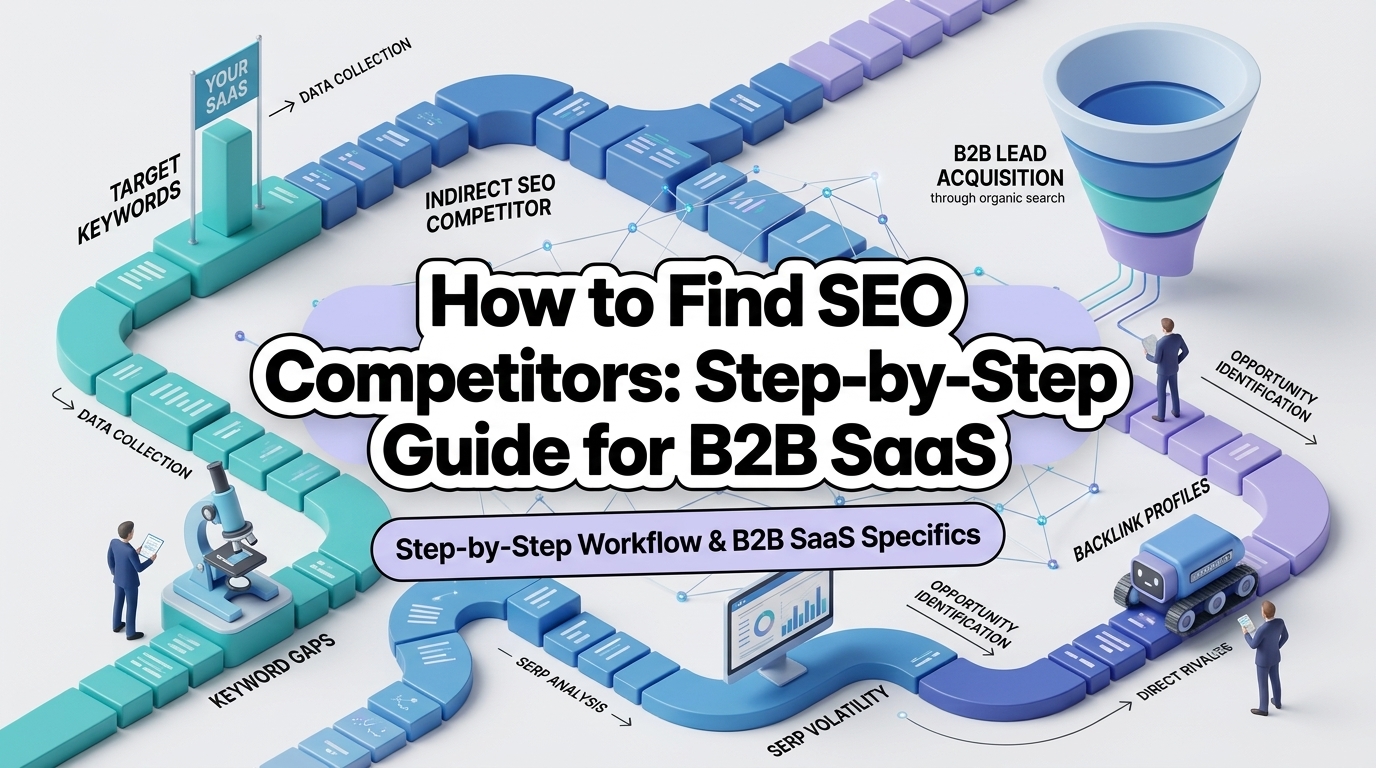
SEO competitor analysis isn’t about copying rivals—it’s about discovering the content gaps, ranking opportunities, and strategic clusters your team can own. For B2B SaaS teams, this process is the difference between chasing generic keywords and building a content moat around high‑intent topics your buyers actually search for.
Below is a practical, tool-backed workflow to find your true SEO competitors, turn their strategies into actionable plans, and integrate the findings into a scalable content pipeline.
What counts as an SEO competitor (and why it’s not obvious)
Most teams equate “competitors” with companies selling similar products. For SEO, that definition is too narrow.
An SEO competitor is any domain ranking for the same target queries your audience uses—regardless of whether it sells a competing tool. For example, Ahrefs and SEMrush compete for keywords like “best backlink checker,” even though they’re direct SaaS rivals. Meanwhile, a freelance consultant’s blog might rank for “how to build a backlink strategy,” making it an SEO competitor even if their business model differs.
In B2B SaaS, SEO competitors often fall into three buckets:
| Type | Example | Why it matters |
|---|---|---|
| Direct SaaS competitors | HubSpot vs. Salesforce for “CRM software” | Same audience, same intent |
| Alternative solutions | Zapier vs. Workato for “workflow automation tools” | Solves similar pain points |
| Non-competing publishers | HubSpot Academy vs. Neil Patel’s blog for “email marketing best practices” | Attracts your ICP with educational content |
The key is to focus on query overlap, not product overlap. Start by listing 10–15 high‑priority buyer intent keywords (e.g., “best AI writing assistant for SaaS,” “how to reduce customer churn in SaaS”). Then identify which domains rank for those queries.
How to find your SEO competitors (6 methods)
Use these methods in sequence to build a comprehensive competitor list. Each uncovers a different slice of the search landscape.
Method 1: Reverse-engineer your top keywords
Run a keyword gap analysis to find domains ranking for the same queries you target.
- Export your top 50–100 target keywords (e.g., from Google Search Console or your content calendar).
- Paste them into Ahrefs’ Site Explorer → Content Gap or SEMrush’s Keyword Gap.
- Add your domain as the first site and your competitors as the second.
- Filter results for:
- Relevance: SaaS, B2B, or ICP-aligned topics
- Traffic share: Prioritize domains with >100 monthly organic visits for those keywords
- Authority: Domain Rating (DR) or Authority Score (AS) between 40–80 for actionable benchmarks
Export the list and flag duplicates. You’ll often see patterns—e.g., most gaps point to review sites like G2 or Capterra, or educational hubs like HubSpot Academy.
Tip: Save these exports as CSV files and store them in a shared drive (Google Drive or Notion) so your team can reference them later.
Method 2: Analyze who ranks in featured snippets and “People also ask”
SERP features reveal low-competition, high-intent opportunities—and the players dominating them.
- Search your target keywords in Google.
- Note domains appearing in:
- Featured snippets (position 0)
- People also ask (PAA) sections
- Top stories or video carousels
- Use a tool like AlsoAsked or AnswerThePublic to scrape PAA questions and map the domains.
Example: For “best SaaS CRM for startups,” a featured snippet from a SaaS review site appears in position 0. That site becomes an SEO competitor for all related queries, even if it doesn’t sell a CRM.
Action: Export these domains into a second list and compare it with your keyword gap results. Overlaps indicate strong competitors; outliers may reveal hidden opportunities.
Method 3: Use Google’s “Related searches” and “Competitors” in Search Console
Google Search Console (GSC) surfaces competitor suggestions directly from your site’s search data.
- Open Google Search Console → Search results.
- Filter for queries where your site ranks on page 2 or 3.
- Click the three-dot menu on any query → “Related searches” to see additional terms.
- Repeat for “Competitors” under the same menu to view domains Google associates with your site.
Export these competitors to a third list. Cross-reference with your previous lists to identify recurring domains—these are your top SEO competitors.
Pro tip: Schedule a quarterly review of GSC’s “Competitors” list to catch new entrants early.
Method 4: Monitor backlinks and co-citations
Backlinks are a proxy for content authority. Domains that link to your site or your target keywords often rank for those topics.
- Use Ahrefs’ Backlink Gap or Moz Link Explorer to compare your backlink profile with competitors.
- Filter for domains linking to multiple competitors (co-citations).
- Prioritize domains with high Referring Domains and Topical Relevance scores.
Example: If 10 SaaS review sites link to both you and a competitor for “best project management software,” that competitor is likely ranking for similar queries—and their content is worth analyzing.
Method 5: Follow industry roundups and “best X” lists
Aggregator sites and “best of” lists are goldmines for competitor content strategies.
- Search for “best [your product category]” or “top [your niche] tools.”
- Note the domains featured in roundups (e.g., G2, Capterra, SaaSHub).
- Review their top-performing pages using Ahrefs’ Top Pages report.
- Extract topic clusters and content angles that rank well.
Example: A “best AI tools for SaaS” list might feature 20 tools, but only 5 have detailed comparison pages ranking in the top 10. Those 5 are your immediate SEO competitors for those queries.
Action: Build a spreadsheet tracking:
- Domain
- Top 3 ranking pages
- Word count
- Content angle (e.g., “pricing,” “alternatives,” “tutorials”)
Method 6: Leverage internal search and support logs
Your users’ queries reveal gaps in your content and competitors they’re evaluating.
- Export internal site search data from Google Analytics 4 or Hotjar.
- Filter for queries containing competitor names (e.g., “alternatives to [competitor]”) or comparison terms (e.g., “[your product] vs [competitor]”).
- Analyze support tickets for phrases like “How does this compare to…?”
These logs highlight:
- Missing comparison content
- Competitor mentions in buyer journeys
- High-intent queries you’re not ranking for
Example: If 30% of support tickets mention “Klaviyo vs Mailchimp,” your team should create a dedicated comparison page—and that page is now a new SEO competitor target.
Tools to automate competitor discovery (with pros/cons)
Automating parts of this process saves hours and ensures consistency. Below is a lightweight starter stack tailored for B2B SaaS teams.
| Tool | Best for | Pros | Cons | Cost |
|---|---|---|---|---|
| Google Search Console | Organic query and competitor data | Free, direct from Google | Limited export options | Free |
| Ahrefs | Keyword gap, backlinks, SERP analysis | Deep data, intuitive UI | Expensive for small teams | $129+/mo |
| SEMrush | Keyword gap, SERP features | Strong competitor tracking | Steep learning curve | $129+/mo |
| Moz | Backlink analysis, domain comparison | Beginner-friendly | Less granular than Ahrefs | $99+/mo |
| AlsoAsked | PAA scraping | Fast, visual outputs | Limited keyword volume | $19+/mo |
| Supermetrics | Data export to Sheets | Automates GSC exports | Requires setup | $49+/mo |
For small teams: Start with GSC + AlsoAsked + a free trial of Ahrefs or SEMrush. Export competitor lists weekly and store them in a shared spreadsheet. Once you have 100+ high-quality competitors, invest in automation tools to scale.
Workflow tip: Export competitor lists directly into your SEO pipeline
If you use an agentic SEO platform (like BlogCrew), import your competitor list as seed data for:
- Keyword research agents
- Brief agents to build content clusters
- Draft agents to create competitor comparison pages
This turns raw competitor data into actionable content plans—without manual copy-pasting.
Turn competitors into actionable content clusters
Now that you have a list of competitors, the next step is to convert them into a cluster-based content strategy.
Step 1: Map competitor top pages by topic and intent
- For each competitor domain, run a Top Pages report in Ahrefs.
- Filter by organic traffic to identify their strongest pages.
- Label each page by:
- Topic (e.g., “pricing,” “alternatives,” “tutorials”)
- Intent (informational, commercial, transactional)
- Opportunity Score (traffic / ranking difficulty)
Example:
| Page | Topic | Intent | Opportunity Score | Notes |
|---|---|---|---|---|
| /pricing | Pricing | Commercial | High | Ranks #2 for “HubSpot pricing” |
| /alternatives | Alternatives | Commercial | Medium | Ranks #5 for “best CRM” |
| /tutorials | Tutorials | Informational | Low | Ranks #10; low traffic |
Step 2: Identify content gaps
Use a content gap analysis to find topics your competitors rank for—but you don’t.
- In Ahrefs, run Content Gap with your domain vs. 3–5 top competitors.
- Filter for keywords where:
- You rank below position 10
- Competitors rank positions 1–3
- Volume > 500/month
- Group results by topic clusters (e.g., “CRM pricing,” “migration guides”).
Example output:
- 12 keywords for “best CRM for startups” where competitors rank in top 3 but you don’t.
- 8 keywords for “how to migrate from Salesforce” with similar gaps.
Step 3: Build a cluster plan
Turn gaps into a topic cluster that strengthens your site authority.
- Select a pillar page (e.g., “Best CRM Software for SaaS Teams”).
- Create cluster pages around subtopics:
- “HubSpot vs Salesforce Pricing”
- “How to Migrate from Salesforce to HubSpot”
- “CRM Alternatives for Startups”
- Link cluster pages to the pillar and to each other.
Why this works:
- Each cluster page targets a high-intent query.
- Internal linking signals topical authority to Google.
- You own the narrative around your product category.
Step 4: Integrate findings into your SEO pipeline
Feed your cluster plan into an agentic SEO workflow:
- Research agent: Ingest your keyword cluster list.
- Brief agent: Generate structured outlines with intent, competitors, and gaps.
- Draft agent: Write cluster pages with competitor comparisons.
- Review agent: Validate SEO checklists and internal linking.
- Publisher: Schedule cluster pages to publish in waves.
Result: A scalable system where competitor research directly fuels content creation—without manual coordination.
Common mistakes to avoid
Even experienced teams fall into traps. Watch for these pitfalls:
-
Ignoring intent Targeting “best CRM” instead of “best CRM for startups” wastes budget. Validate intent with SERP analysis and PAA questions.
-
Over-focusing on Domain Authority A DR 90 site ranking for “how to use a CRM” may outperform your DR 70 site for “best CRM for SaaS.” Relevance beats authority.
-
Missing indirect competitors Freelancers, aggregators, and niche blogs often rank for high-intent queries. Don’t overlook them.
-
Not updating analysis quarterly Competitor landscapes shift fast. Schedule a quarterly review to refresh your competitor list and cluster plan.
-
Treating competitor analysis as a one-time task Treat it as an ongoing process tied to your content calendar. Use agentic tools to automate updates and flag new entrants.
Quick checklist for your next competitor analysis
- List 10–15 high-intent keywords from your content calendar
- Run keyword gap analysis in Ahrefs/SEMrush
- Export SERP features from AlsoAsked
- Pull competitor data from GSC
- Map top competitor pages by topic and intent
- Identify 5–10 content gaps with opportunity scores
- Build a cluster plan with pillar + cluster pages
- Schedule quarterly reviews
Bottom line
Finding SEO competitors isn’t about listing rivals—it’s about uncovering the content gaps and ranking opportunities your team can own. By combining keyword gap analysis, SERP feature mining, backlink tracking, and internal search data, you build a competitor map that powers your entire content strategy.
The next step? Turn that map into a cluster-based content plan and feed it into an agentic SEO pipeline where research, briefing, drafting, and publishing happen on a single board—without juggling five tools or losing context.
Start small: pick 3 high-intent keywords, run a keyword gap analysis, and export your first competitor list today. The insights will shape your next quarter of organic growth.