How to Use AI for SEO Content Without Breaking the Rules
 Thu Nghiem
SEO teams struggle to balance speed and quality, but AI can help—if applied systematically. Learn how to build an agentic SEO pipeline that scales high-quality content while maintaining control, compliance, and performance.
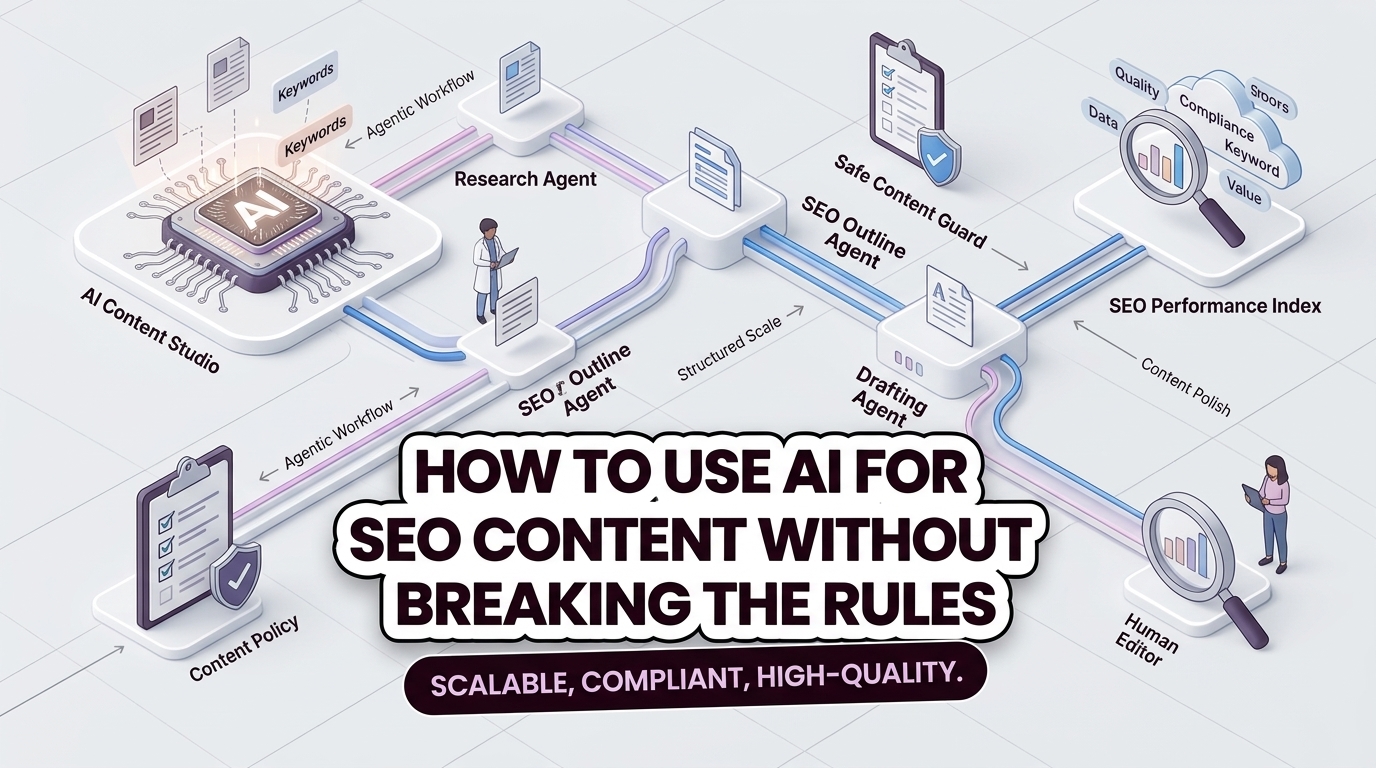
SEO teams are under pressure to publish more content faster—but shortcuts often backfire. Duplicate drafts, brand drift, and shallow posts hurt rankings and waste resources. The solution isn’t less AI; it’s more structure. A controlled, agentic workflow turns generative AI from a risk into a repeatable engine for high-quality SEO content.
This guide shows how to integrate AI into your SEO pipeline while maintaining control, compliance, and performance. You’ll learn how to deploy specialized agents for research, briefing, drafting, reviewing, and publishing—all within a single board that keeps your team aligned and your content safe.
Why AI for SEO matters now
Content demand has never been higher, but SEO budgets aren’t growing proportionally. Marketing teams face two conflicting goals: scale output and preserve quality.
AI can help—but only if applied systematically. Free-form experimentation leads to tool sprawl: one tool for research, another for drafting, a third for publishing, and four spreadsheets to track it all. The result? Inconsistent briefs, disjointed drafts, and a maintenance nightmare.
Agentic SEO changes the game. Instead of asking, 'Which AI tool should we use?' you build a pipeline where specialized agents handle specific tasks under human oversight. Each agent does one job well—research intent, build structured briefs, draft articles, run compliance checks, generate images, and schedule publishes—so your team retains control without sacrificing speed.
How AI fits into a modern SEO workflow
Traditional “AI write everything” approaches treat generative models like a magic wand. You prompt a tool, watch it spin up a draft, and hope for the best. The result is often a mediocre article that needs heavy editing, or worse, content that violates guidelines and tanks in rankings.
A modern SEO workflow distributes the work across specialized agents:
| Stage | Traditional approach | Agentic approach |
|---|---|---|
| Research | Manual keyword lists in spreadsheets | Research agent pulls Search Console data and analyzes search intent |
| Briefing | Ad-hoc outlines with missing context | Brief agent creates structured outlines with SEO targets and intent signals |
| Drafting | Generic AI output with brand drift | Draft agent produces on-brand, well-structured articles based on approved briefs |
| Reviewing | Manual checklist in a doc | Review agent runs SEO, compliance, and brand checks before human approval |
| Publishing | Separate CMS and image tools | Publisher agent schedules posts and auto-generates hero/OG images from one board |
The agentic model treats AI as a team of reliable specialists—not a replacement for strategy or oversight. It transforms chaos into a predictable pipeline where every draft is reviewed, every brief is intentional, and every publish is auditable.
Step-by-step: Build an agentic AI SEO pipeline
Follow these steps to set up a controlled AI workflow that scales quality content without breaking the rules.
Step 1: Set up your research agent
Start by feeding real performance data into your research pipeline.
- Connect your Search Console to a research agent that analyzes click-through rates, query intent, and content gaps.
- Tag queries by intent (informational, commercial, transactional) so your briefs target the right audience.
- Identify clusters where one piece of content can strengthen others—depth over isolated posts.
This step replaces guesswork with data. Instead of relying on keyword volume alone, you build content around proven demand and intent.
Step 2: Create structured briefs with intent and SEO targets
Use a brief agent to transform research into actionable briefs.
- Input: search intent, target keywords, competitor gaps, and brand guidelines.
- Output: a structured outline with headings, word count, internal link targets, and semantic clusters.
- Human review: approve or iterate before drafting begins.
Structured briefs ensure every draft aligns with search intent and business goals. Agents handle the heavy lifting; humans preserve quality.
Step 3: Draft with AI writers, retain human approval before publish
Draft agents generate full articles based on approved briefs.
- Agents use your brand style guide and tone to maintain consistency.
- Drafts are delivered as editable content—not final copies—so you can refine messaging, add nuance, and optimize for conversions.
- No article moves forward without human sign-off.
This human-in-the-loop gate prevents brand drift and ensures every piece meets editorial standards.
Step 4: Use review agents to run SEO checklists and compliance checks
Deploy a review agent to automate quality control.
- SEO checklist: checks keyword density, internal linking, meta tags, and readability.
- Compliance checklist: validates adherence to brand guidelines and EU-specific data handling (if applicable).
- Audit trail: logs every change and approval for future reference.
Automated reviews catch errors before they reach the public, reducing post-publication fixes and ranking drops.
Step 5: Schedule and publish from one board with automated image generation
Publish articles directly from your pipeline.
- Drag-and-drop articles across stages: draft → review → scheduled → published.
- Image generator creates hero and OG images automatically based on article content.
- Publisher agent handles scheduling, CMS pushes, and webhook integrations (Zapier, n8n, Make) to third-party platforms.
Everything stays in one place. No more context switching between tools, spreadsheets, and dashboards.
Best practices: Keep AI content safe and effective
AI accelerates content creation—but only when controlled. Follow these principles to maintain quality, compliance, and performance.
Human-in-the-loop: nothing publishes without review
Every draft must pass human approval before going live. This gate ensures:
- Brand voice consistency
- Accurate messaging and claims
- Proper attribution and compliance
Agents draft; humans decide. This balance preserves quality without slowing progress.
Depth over volume: focus on keyword clusters, not isolated posts
A single article rarely ranks for more than a few queries. Clusters do the heavy lifting.
- Plan a pillar page and supporting posts that reinforce each other.
- Use internal links to build topical authority.
- Ensure each piece targets a distinct intent and query.
Clusters create a foundation for sustained organic growth—not a burst of short-term traffic.
Brand consistency: use style guides and review checkpoints
AI can mimic tone, but it doesn’t understand nuance. Mitigate drift with:
- A documented style guide (tone, terminology, formatting).
- Regular review checkpoints at draft and pre-publish stages.
- Agent prompts that reference your brand guidelines.
Consistency builds trust with readers and search engines alike.
EU compliance: workspace isolation, audit trails, TLS encryption
If your team operates in or serves EU markets, compliance matters.
- Use EU-hosted workspaces to meet data residency requirements.
- Enable workspace isolation to segment projects and reduce risk.
- Maintain audit trails for every article’s journey from brief to publish.
- Enforce TLS encryption for data in transit.
These measures protect your content—and your reputation.
Tools and integrations: What to look for
Not all AI tools are built for structured SEO workflows. Prioritize platforms that offer:
- Structured briefs: outlines with intent, targets, and internal link plans.
- Agentic pipelines: multi-agent workflows that preserve context across stages.
- Approval gates: human review before any publish or export.
- Integrated publishing: direct CMS pushes, webhooks, or native destinations.
- Compliance features: EU hosting, audit logs, and role-based access.
Compare tools using this checklist:
| Feature | Required | Nice to have |
|---|---|---|
| Search Console integration | ✅ | — |
| Intent analysis in briefs | ✅ | — |
| Multi-agent workflows | ✅ | — |
| Human approval before publish | ✅ | — |
| EU hosting & TLS encryption | ✅ (EU teams) | — |
| Image generation per article | — | ✅ |
| Webhook support (Zapier, n8n, Make) | — | ✅ |
| BlockForm publishing (conversion-optimized pages) | — | ✅ |
| Audit trails & workspace isolation | — | ✅ |
If you’re evaluating options, ask: Does this tool reduce fragmentation or add another tab to juggle?
Common pitfalls and how to avoid them
Even well-intentioned teams fall into traps when adopting AI for SEO. Recognize these risks and plan around them.
Over-reliance on AI without human review
AI drafts are faster, but not always better. Always run drafts through human editors.
- Assign clear ownership for final approval.
- Use style guides to guide AI prompts and human edits.
- Schedule regular content audits to catch drift early.
Publishing AI drafts verbatim without optimization
AI-generated content often needs refinement.
- Add unique insights, examples, and data not found in top ranking pages.
- Optimize meta descriptions and headers for CTR.
- Include conversion-focused CTAs where relevant.
Treat AI as a co-writer—not a final draft.
Ignoring intent and keyword clusters
Volume metrics aren’t enough. Intent alignment drives rankings.
- Validate intent with real query data (Search Console, rank tracking).
- Build clusters around core topics and supporting subtopics.
- Use internal links to reinforce topical authority.
Depth beats volume every time.
Tool fragmentation (five tools doing one thing each)
Juggling separate tools for research, drafting, reviewing, and publishing adds friction.
- Consolidate into a single workflow board.
- Ensure agents share context across stages.
- Eliminate manual handoffs and context loss.
Fragmentation slows teams down and increases error rates.
Measuring success: Metrics that matter
Track pipeline efficiency and content performance to prove ROI.
Pipeline KPIs
- Brief-to-draft time: How long from brief approval to first draft.
- Cluster-to-publish time: How quickly a cluster of related posts goes live.
- Agent utilization: How often each agent is used per article.
- Approval rate: Percentage of drafts approved without major revisions.
Example: A mature agentic pipeline can cut brief-to-draft from days to hours.
Content quality metrics
- SERP rankings: Track target queries over time.
- Organic traffic: Measure growth from published clusters.
- Conversion paths: Monitor how content drives leads and sign-ups.
- Bounce rate & time on page: Assess engagement quality.
Quality content ranks higher and converts better.
Team efficiency metrics
- Tool consolidation: fewer tools, fewer logins, less context switching.
- Role clarity: clear ownership for research, briefing, drafting, and reviewing.
- Audit readiness: pre-built logs for compliance and security reviews.
Efficiency isn’t just about speed—it’s about predictability.
Start small, scale with confidence
You don’t need to overhaul your entire workflow overnight. Begin with a single cluster: research intent, brief one pillar, draft supporting posts, review and publish. Measure the results, refine the process, then expand.
Agentic SEO isn’t about replacing humans—it’s about empowering them. With structured pipelines, specialized agents, and human approval gates, AI becomes a force multiplier for high-quality, compliant, and high-performing content.
Ready to ship SEO content from one board—without breaking the rules? Start by mapping your first agentic pipeline today.