Search Engine Ranking Factors 2026: What Will Matter Most?
 Thu Nghiem
Discover the key search engine ranking factors for 2026, including AI-driven signals, evolving UX metrics, and technical SEO trends. Learn how to future-proof your SEO strategy with actionable insights and expert projections.
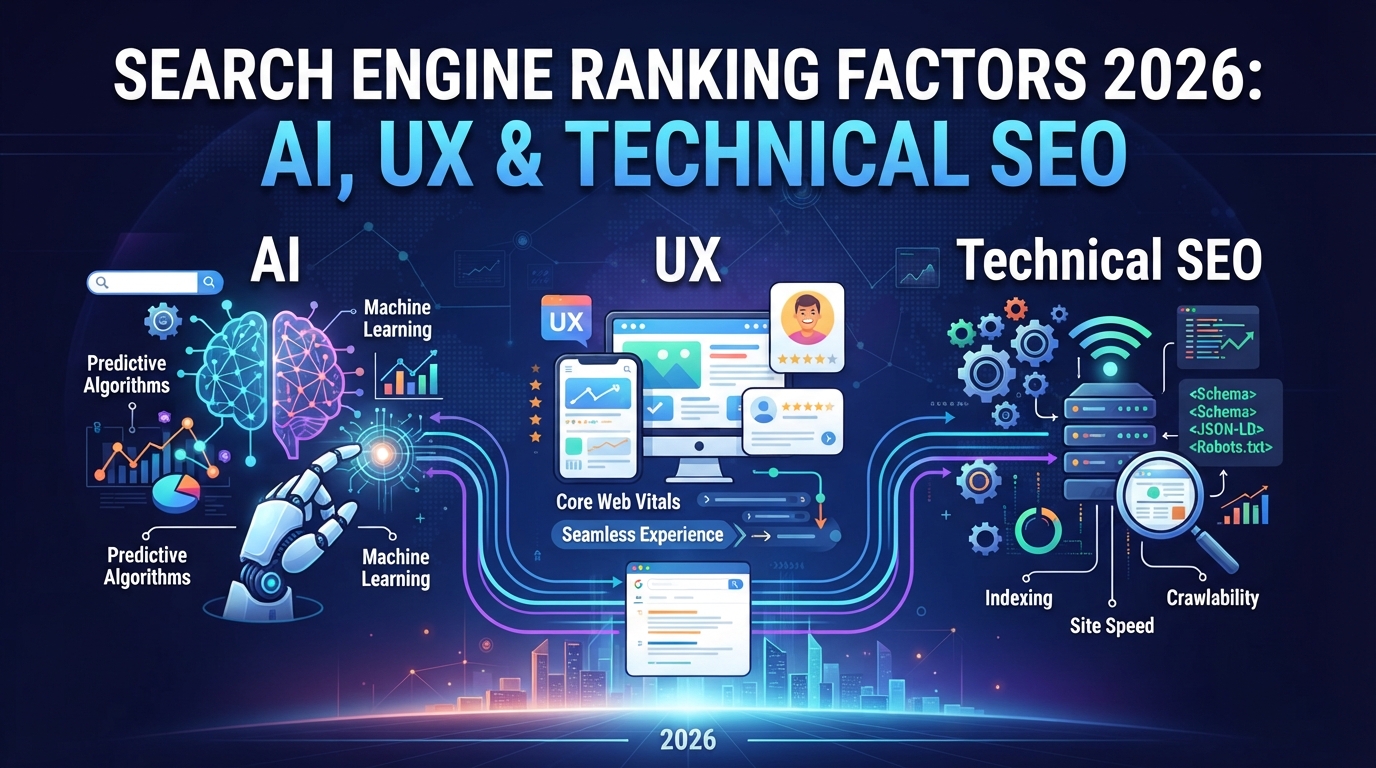
By 2026, the search landscape will look nothing like it does today. Google’s algorithms are evolving at an unprecedented pace, driven by advances in artificial intelligence, shifting user behaviors, and a relentless focus on delivering hyper-personalized, contextually relevant results. If you’re still optimizing for ranking factors from 2023, you’re already falling behind.
This isn’t just another list of “top SEO trends.” It’s a forward-looking guide to the ranking factors that will dominate search in 2026—backed by industry projections, expert insights, and actionable strategies to future-proof your SEO efforts. Whether you’re a digital marketer, SEO specialist, or business owner, understanding these shifts will help you stay ahead of algorithm updates and maintain long-term visibility.
Here’s what you need to know.
Why Ranking Factors Are Evolving Faster Than Ever
Search engines have always prioritized delivering the best possible results to users. What’s changing is how they determine what “best” means. Three key forces are accelerating this evolution:
- AI and machine learning: Google’s algorithms are no longer static rule-based systems. They’re dynamic, self-improving models that learn from user behavior in real time. By 2026, AI will influence over 60% of search results, according to a report by Gartner.
- User expectations: People don’t just want answers—they want personalized answers, delivered instantly and in the format that suits them best (text, video, voice, or interactive content).
- Technological advancements: From real-time indexing to post-quantum cryptography, search engines are adopting cutting-edge tech to improve speed, security, and relevance.
The result? Ranking factors that were once static (like keyword density or backlink quantity) are giving way to dynamic, AI-driven signals that prioritize context, intent, and user satisfaction.
If you’re not preparing for these changes now, you’ll be playing catch-up in 2026.
The Core Ranking Factors of 2026 (And What’s Fading)
Some ranking factors will remain foundational, but their weight and interpretation will shift. Others will fade into obscurity—or even become liabilities. Here’s what to focus on (and what to leave behind).
Traditional Factors Still Relevant (But With Twists)
1. Backlinks: Quality Over Quantity, With AI-Validated Relevance
Backlinks aren’t going away, but their role is evolving. In 2026, search engines will prioritize:
- Topical authority: Links from sites that are deeply relevant to your niche will carry more weight than generic high-DA (Domain Authority) links.
- AI-validated relevance: Google’s algorithms will use natural language processing (NLP) to assess whether a backlink is contextually meaningful or just a manipulative attempt to game rankings.
- Linkless mentions: Brand citations (even without a hyperlink) may influence rankings, as search engines increasingly associate mentions with authority.
What to do:
- Focus on earning links from industry-leading publications, niche forums, and thought leaders.
- Avoid low-quality guest posts, PBNs (Private Blog Networks), and paid links—AI will detect and penalize these faster than ever.
2. Content Depth: E-E-A-T Expands to Include “Contextual Utility”
Google’s E-E-A-T (Experience, Expertise, Authoritativeness, Trustworthiness) framework will evolve to include a new dimension: contextual utility. This means content must:
- Serve specific user intents (e.g., answering a micro-moment like “best running shoes for flat feet” with precise, actionable advice).
- Demonstrate firsthand experience (e.g., product reviews from actual users, not just regurgitated specs).
- Provide multimodal value (e.g., combining text, video, and interactive elements to engage users across formats).
What to do:
- Audit your content for depth and originality. Does it answer why and how, or just what?
- Incorporate user-generated content (UGC), expert quotes, and real-world examples to bolster credibility.
3. Technical SEO: Core Web Vitals Evolve to “Perceived Performance”
Core Web Vitals (LCP, FID, CLS) will remain important, but search engines will also measure perceived performance—how users experience your site, not just how it loads. Key metrics will include:
- AI-driven load-time predictions: Google may use machine learning to predict how fast a page feels to users, even if the raw metrics are suboptimal.
- Interactive engagement: Time to first interaction (e.g., clicking a button, scrolling) will matter more than time to full load.
- Mobile-first indexing 2.0: With voice search and app integration, sites must optimize for “zero-click” scenarios (e.g., featured snippets, app deep links).
What to do:
- Prioritize user-centric performance optimizations (e.g., lazy-loading non-critical resources, reducing JavaScript bloat).
- Test your site on low-end devices and slow networks to identify friction points.
Fading Factors: What to Leave Behind
Some ranking factors that once moved the needle will lose their impact—or even hurt your rankings. These include:
- Keyword density: Stuffing keywords is already a red flag; by 2026, it’ll be a surefire way to trigger AI spam filters.
- Exact-match domains: Google’s algorithms have long since moved past rewarding “bestplumbersinnewyork.com” with top rankings.
- Manipulative link schemes: Paid links, link farms, and reciprocal linking will be detected and penalized faster than ever.
- Over-optimized anchor text: Exact-match anchor text (e.g., “buy blue widgets”) will look unnatural to AI and may trigger penalties.
What to do:
- Shift from keyword optimization to topic optimization. Cover subjects comprehensively, not just individual keywords.
- Build links organically through high-quality content and genuine relationships.
AI and Machine Learning: The New Arbiters of Search
AI isn’t just a tool for search engines—it’s becoming the primary mechanism for ranking content. Here’s how it will reshape SEO in 2026.
How AI Is Reshaping Ranking Signals
1. Predictive Search and the Rise of SGE
Google’s Search Generative Experience (SGE) is just the beginning. By 2026, AI-powered search will:
- Generate answers on the fly: Instead of returning a list of links, search engines will synthesize information from multiple sources into a single, AI-generated response.
- Impact CTR and dwell time: If users get answers directly in the search results, organic click-through rates (CTR) may drop by 20–30%, according to a study by SparkToro. Sites that provide unique value (e.g., deep dives, interactive tools) will still attract clicks.
- Prioritize “conversational” content: AI favors content that mimics natural language, answers follow-up questions, and adapts to user context.
What to do:
- Optimize for conversational queries (e.g., “How do I fix a leaky faucet?” instead of “plumbing repair tips”).
- Structure content to answer nested questions (e.g., “What tools do I need?” → “How do I use them?”).
2. Hyper-Personalization: The End of “One-Size-Fits-All” Rankings
AI will tailor search results based on:
- User behavior: Past searches, clicks, and dwell time will influence future rankings.
- Device and context: A mobile user searching for “coffee shops” at 8 AM will see different results than a desktop user searching at 2 PM.
- Location and intent: Search engines will distinguish between “I want to buy a coffee maker” and “I want to learn how to brew coffee.”
What to do:
- Create dynamic content that adapts to user intent (e.g., location-based landing pages, intent-specific CTAs).
- Use tools like Google’s Natural Language API to analyze how your content aligns with different intents.
3. AI-Powered Content Evaluation
Google’s “Helpful Content System” is just the first step. By 2026, AI will assess content based on:
- Originality: Does your content offer unique insights, or is it just a rehash of existing information?
- Depth: Does it cover a topic comprehensively, or just scratch the surface?
- User satisfaction: AI will analyze engagement metrics (e.g., scroll depth, shares, saves) to determine whether users found your content valuable.
What to do:
- Avoid thin or generic content. Every piece should pass the “so what?” test—why should users care?
- Use AI tools (e.g., Clearscope, SurferSEO) to identify content gaps and optimize for depth.
The Risks of AI-Generated Content
While AI can help scale content creation, it also introduces risks:
- Hallucinations: AI-generated content may include factual inaccuracies or nonsensical claims.
- Lack of originality: Search engines will penalize content that’s indistinguishable from other AI-generated pieces.
- Over-optimization: AI tools may overuse keywords or produce unnatural phrasing, triggering spam filters.
What to do:
- Use AI as a co-pilot, not a replacement. Always fact-check and add human insights.
- Focus on unique angles (e.g., case studies, expert interviews) to stand out from AI-generated noise.
User Experience (UX) and Behavioral Signals: The Silent Ranking Factors
Search engines are getting better at measuring how users interact with your content. In 2026, UX and behavioral signals will play a bigger role than ever.
Beyond Core Web Vitals: Engagement Metrics That Matter
1. Scroll Depth and Session Duration
- Scroll depth: How far users scroll down a page signals whether your content is engaging. A study by Chartbeat found that content with higher scroll depth ranks better.
- Session duration: The longer users stay on your site, the more likely search engines are to view it as valuable.
What to do:
- Use content chunking (e.g., subheadings, bullet points, visuals) to keep users engaged.
- Include interactive elements (e.g., quizzes, calculators) to extend session duration.
2. Content Interaction Rate
Search engines will track how users interact with your content, including:
- Shares and saves: Content that’s frequently bookmarked or shared on social media will rank higher.
- Comments and discussions: Pages that spark conversations (e.g., blog comments, forum threads) will be seen as more valuable.
- Dwell time: The time between a user clicking on your result and returning to the search page.
What to do:
- Encourage engagement with clear CTAs (e.g., “Save this for later,” “Share your thoughts in the comments”).
- Use multimedia (e.g., videos, infographics) to keep users on the page longer.
3. Mobile-First Indexing 2.0
Mobile-first indexing isn’t new, but in 2026, it will evolve to include:
- Voice search optimization: With 50% of searches expected to be voice-based by 2026 (per Comscore), sites must optimize for conversational queries.
- App integration: Search engines will prioritize content that seamlessly integrates with mobile apps (e.g., deep links, app indexing).
- Zero-click optimization: Featured snippets, knowledge panels, and other “zero-click” results will dominate mobile SERPs.
What to do:
- Optimize for long-tail, conversational queries (e.g., “What’s the best Italian restaurant near me with outdoor seating?”).
- Implement schema markup to increase your chances of appearing in featured snippets.
The Rise of “Intent Matching”
Search engines are getting better at understanding why users search. In 2026, they’ll prioritize content that aligns with three core intents:
Intent TypeExample QueryContent StrategyInformational“How does photosynthesis work?”In-depth guides, tutorials, explainer videosNavigational“Facebook login”Clear, concise landing pagesTransactional“Buy iPhone 15 Pro”Product pages, comparison tables, CTAs
What to do:
- Use tools like Google’s Natural Language API or AnswerThePublic to identify intent behind keywords.
- Create intent-specific content (e.g., a “how-to” guide for informational queries, a product page for transactional queries).
Technical SEO in 2026: What You Can’t Ignore
Technical SEO will remain the backbone of search visibility, but the priorities are shifting. Here’s what you need to focus on.
Emerging Technical Priorities
1. Real-Time Indexing for Dynamic Content
Search engines are moving toward real-time indexing, which means:
- Live blogs and UGC: Content that updates frequently (e.g., live blogs, user-generated reviews) will be indexed faster.
- Dynamic pages: Sites with personalized content (e.g., e-commerce product recommendations) will need to ensure search engines can crawl and index these pages efficiently.
What to do:
- Use Google’s Indexing API to notify search engines of new or updated content.
- Implement server-side rendering (SSR) or static site generation (SSG) to improve crawlability.
2. Structured Data for AI Comprehension
Schema markup isn’t just for rich snippets anymore—it’s becoming essential for AI comprehension. In 2026, search engines will rely on structured data to:
- Understand context (e.g., whether “Apple” refers to the fruit or the company).
- Identify relationships between entities (e.g., a recipe’s ingredients, a product’s features).
- Generate AI-powered responses (e.g., SGE snippets).
What to do:
- Implement advanced schema types (e.g., FAQ, HowTo, Event, Product).
- Use Google’s Rich Results Test to validate your markup.
3. Security: Post-Quantum Cryptography and Privacy-First Indexing
With cyber threats on the rise, search engines will prioritize secure and privacy-compliant sites. Key trends include:
- Post-quantum cryptography: As quantum computing advances, sites will need to adopt quantum-resistant encryption (e.g., CRYSTALS-Kyber).
- Privacy-first indexing: Google’s Privacy Sandbox will replace third-party cookies, requiring sites to adopt first-party data strategies.
What to do:
- Migrate to HTTPS if you haven’t already.
- Audit your site for privacy compliance (e.g., GDPR, CCPA) and implement first-party data collection (e.g., email signups, loyalty programs).
Legacy Issues to Fix Now
1. Crawl Budget Optimization
Large sites (e.g., e-commerce, news publishers) often waste crawl budget on low-value pages. In 2026, this will hurt rankings.
What to do:
- Use Google Search Console to identify crawl errors and blocked resources.
- Implement noindex tags for thin or duplicate content.
- Optimize internal linking to prioritize high-value pages.
2. JavaScript Rendering and “Hidden Content” Penalties
Search engines are getting better at rendering JavaScript, but poorly implemented JS can still cause issues:
- Delayed rendering: If your content relies on client-side JS, search engines may not see it until after the initial crawl.
- Hidden content: Content that’s only visible after user interaction (e.g., accordions, tabs) may be deprioritized.
What to do:
- Use server-side rendering (SSR) or static site generation (SSG) to ensure content is crawlable.
- Avoid hiding critical content behind user interactions.
Preparing for 2026: A Proactive SEO Checklist
The best time to prepare for 2026 is now. Here’s a step-by-step checklist to future-proof your SEO strategy.
Short-Term Actions (2024–2025)
1. Audit Your Content for E-E-A-T and Contextual Utility
- Check for depth: Does your content answer why and how, or just what?
- Add firsthand experience: Include expert quotes, case studies, or user-generated content.
- Optimize for micro-moments: Break down broad topics into specific, actionable subtopics.
2. Improve Technical SEO
- Core Web Vitals: Aim for “Good” scores in LCP, FID, and CLS.
- Structured data: Implement schema markup for key pages (e.g., FAQ, HowTo, Product).
- Mobile optimization: Test your site on low-end devices and slow networks.
3. Build Topical Authority
- Earn high-quality backlinks: Focus on topical relevance over Domain Authority.
- Publish thought leadership content: Write original research, opinion pieces, or industry reports.
- Engage in niche communities: Participate in forums, LinkedIn groups, or Twitter discussions to build authority.
Long-Term Strategies (2026 and Beyond)
1. Invest in AI Tools for Content Creation and Optimization
- Content optimization: Use tools like SurferSEO or Clearscope to identify gaps and optimize for depth.
- AI-assisted writing: Use Jasper or Copy.ai to generate drafts, but always add human insights.
- Predictive analytics: Use Google Trends or Exploding Topics to identify emerging queries.
2. Experiment with Multimodal Content
- Video: Create short-form (TikTok, Reels) and long-form (YouTube) videos to capture different intents.
- Podcasts: Repurpose audio content into blog posts or transcripts.
- Interactive content: Build quizzes, calculators, or tools to engage users.
3. Monitor Algorithm Updates and Adapt Quickly
- Google’s Search Status Dashboard: Track updates in real time.
- SEO communities: Join r/SEO, Moz Blog, or Search Engine Journal for insights.
- A/B testing: Experiment with different content formats, CTAs, and UX elements to see what works.
Conclusion: The Future of SEO Is Adaptability
The search landscape of 2026 will reward those who embrace change—not those who cling to outdated tactics. While traditional ranking factors like backlinks and content quality will remain important, the real differentiators will be:
- AI-driven personalization: Optimizing for individual user intent, not just broad keywords.
- Technical excellence: Ensuring your site is fast, secure, and crawlable in an AI-first world.
- User-centricity: Creating content that engages, informs, and delights users across all devices and formats.
The key to success? Start optimizing for 2026 today. Audit your content, improve your technical SEO, and experiment with AI and multimodal content. The sooner you adapt, the further ahead you’ll be when the next wave of algorithm updates arrives.
The future of search is here—are you ready?